Teve início o novo projecto Arqueología del campo de concentración de Casa del Guarda.
António João
Publicado em: António João
Pesquisa
Agenda
Escolher mêsMês actual
abril, 2022
Tipologia do Evento:
Todos
Todos
Apresentação
Ciclo
Colóquio
Conferência
Congresso
Curso
Debate
Encontro
Exposição
Inauguração
Jornadas
Lançamento
Mesa-redonda
Mostra
Open calls
Outros
Palestra
Roteiro
Seminário
Sessão de cinema
Simpósio
Workshop
3
- Event Name
seg
ter
qua
qui
sex
sab
dom
–
–
–
–
1
2
3
4
5
6
7
8
9
10
11
12
13
14
15
16
17
18
19
20
21
22
23
24
25
26
27
28
29
30
The 1974 Carnation Revolution{ “@context”: “http://schema.org”,
“@type”: “Event”,
“name”: “The 1974 Carnation Revolution”,
“startDate”: “2022-4-7T16-16-00-00”,
“endDate”: “2022-4-7T18-18-00-00”,
“image”:”https://ihc.fcsh.unl.pt/wp-content/uploads/2022/01/2022-02-03_Lusophone-Africa-00_1200x500.jpg”,
“description”:”Sétimo seminário do ciclo que procura colmatar a lacuna de conhecimento sobre o contributo dos movimentos de libertação das colónias portuguesas para a Guerra Fria e vice-versa.
“@type”: “Event”,
“name”: “The 1974 Carnation Revolution”,
“startDate”: “2022-4-7T16-16-00-00”,
“endDate”: “2022-4-7T18-18-00-00”,
“image”:”https://ihc.fcsh.unl.pt/wp-content/uploads/2022/01/2022-02-03_Lusophone-Africa-00_1200x500.jpg”,
“description”:”Sétimo seminário do ciclo que procura colmatar a lacuna de conhecimento sobre o contributo dos movimentos de libertação das colónias portuguesas para a Guerra Fria e vice-versa.
Lusophone Africa”,
}
Detalhes do Evento
Sétimo seminário do ciclo que procura colmatar a lacuna de conhecimento sobre o contributo dos movimentos de libertação das colónias portuguesas para a Guerra Fria e vice-versa.
Lusophone Africa
Ver mais
Detalhes do Evento
Sétimo seminário do ciclo que procura colmatar a lacuna de conhecimento sobre o contributo dos movimentos de libertação das colónias portuguesas para a Guerra Fria e vice-versa.
Lusophone Africa and the Global Cold War:
New International and Regional Perspectives
Seminar Series
February – April 2022
Thursdays, 4-6PM on Zoom
Since the publication of Odd Arne Westad’s The Global Cold War, the literature on the implications of the Cold War in Africa has mushroomed to incorporate new, previously ignored actors and perspectives. Scholars have focused their research in particular on the Southern African region, since minority rule there lasted the longest and was tied up with superpower conflicts, perhaps like nowhere else on the continent. Some focused on the agency of white minority regimes. Others re-wrote the history of Southern African liberation movements, often using ‘transnational’ rather than specifically Cold War perspectives. However, there is a vast historiographical imbalance with respect to the histories of liberation movements as a whole. The literature on South Africa is vast, yet the Portuguese-speaking Africa (including the colonies of Angola, Mozambique, Guinea-Bissau, Cape Verde, São Tomé and Príncipe) has received significantly less attention from Cold War historians. To date, most research focuses on implications of key moments, such as the Angolan Civil War and the Battle of Cuito Cuanavale. However, we know significantly less about the contribution of the liberation movements in Portugal’s colonies for the Cold War and vice versa. This is all the more surprising because the Lusophone liberation movements were at the forefront of much of the armed struggle in Africa in the 1960s-70s. Moreover, the dissolution of the Portuguese empire led to the establishment of Marxist-inspired regimes in the previous colonies.
This seminar series seeks to address this gap, in view of new perspectives and sources. We aim to look at the interplay between ideologies of liberation and the Cold War in the 1960s and the early 1970s, when the liberation movements engaged in armed struggle in Angola, Mozambique and Guinea-Bissau. The seminar series aims to establish how the movements that came to dominate ‘national liberation’ in Lusophone Africa (from the largest movements – MPLA, FRELIMO and PAIGC – to smaller ones like FNLA, UNITA, COREMO and FLING) both shaped and were shaped by experiences of exile and armed struggle in the context of the Global Cold War. We also examine the motivations of those who decided to ‘opt out’ and fight alongside the Portuguese as well as to investigate the socio-economic projects behind the liberation struggles. Finally, the seminar series will investigate the global repercussions of liberation struggles in Lusophone colonies for both its supporters and rivals.
Programme
Seminar 1. Ideas of Liberation I: Between Marxism and Nationalism
From “liberated zones” to “liberated zone of humanity”: Frelimo and the indivisibility of the state
Eric Allina
TBC
Teresa Almeida Cravo
Discussant: Elizabeth Banks
Date: 3 February 2022, 4-6PM
Seminar 2. Ideas of Liberation II: Alternative Projects
Holden Roberto’s Angolan Revolutionary Government in Exile, 1961-1964
Alex Marino
Unfortunate Bedfellow: Coremo’s relationship with the FNLA
Lazlo Passemiers
Trading Human Rights for Base Rights: The United States and the support for UPA in the early years of the war in Angola
Luis Nuno Rodriques
Discussant: Justin Pearce
Date: 10 February 2022, 4-6PM
Seminar 3. Regional and International Networks I: The United Nations
The Year after Africa: Angola, Goa, and the Embrace of Armed Revolution
Joseph Parrott
The United Nations Decolonization Committee and Foreign Investments in Portugese Colonies, 1965-1974
Aurora Almada e Santos
Discussant: Patricia Gomes
Date: 17 February 2022, 4-6PM
Seminar 4. The Socialist World: People, Ideas, and Contacts with Lusophone Africa
Czechoslovakia and Angola after 1975: the Role of Czechoslovak experts
Barbora Menclova
The Revolution Televised: Frelimo and National Liberation in East Germany
George Bodie
Observing China, Containing China, Competing with China
Jan Adamek
Discussant: George Roberts
Date: 3 March 2022, 4-6PM
Seminar 5. Amílcar Cabral and the Liberation of Guinea-Bissau
TBC
Mustafah Dhada
Traveling Theory: Locating and Discussing Marxism in Amilcar Cabral’s Discourse
Rita Lucas Narra
Discussant: TBC
Date: 10 March 2022, 4-6PM
Seminar 6. International and Regional Networks II. Support for Liberation Movements
The public diplomacy of the liberation movements and its western intermediaries
Ana Moledo
The Toronto Committee for the Liberation of Portugal’s African Colonies (TCLPAC) and the support for the liberation of liberation of Angola and Mozambique (1972-1975)
Marcal De Menezes Paredes
Fighting for neutrality and non-alignment. The Liberation movements of the Portugese Colonies and the Afro-Asian Conference
Juliao Soares Sousa
Discussant: Pedro Aires Oliveira
Date: 30 March 2022, 4-6PM
Seminar 7. The 1974 Carnation Revolution: New Perspectives
The Condor Spreads Wings: The Latin American Secret Missions in Africa after the Carnation Revolution (1974)
Gisele Lobato
The PAIGC’s Non-Alignment in the Cold War Context
Victor Barros
Discussant: TBC
Date: 7 April 2022, 4-6PM
Seminar 8. Representations of Revolution
The Afterlives of Amílcar Cabral: obituaries as biographical narratives shaped by Cold War
Leonor Pires Martins
Guinea-Bissau: a national cinema forged in the fight
Paulo Cunha
Discussant: TBC
Date: 14 April 2022, 4-6PM
Organisers:
Natalia Telepneva (University of Strathclyde). Email: natalia.telepneva@strath.ac.uk
Rui Lopes (IHC — NOVA University Lisbon / IN2PAST and Birkbeck, University of London) Email: ruilopes@fcsh.unl.pt
If you would like to attend this seminar series, please email the organisers to be added to the mailing list.
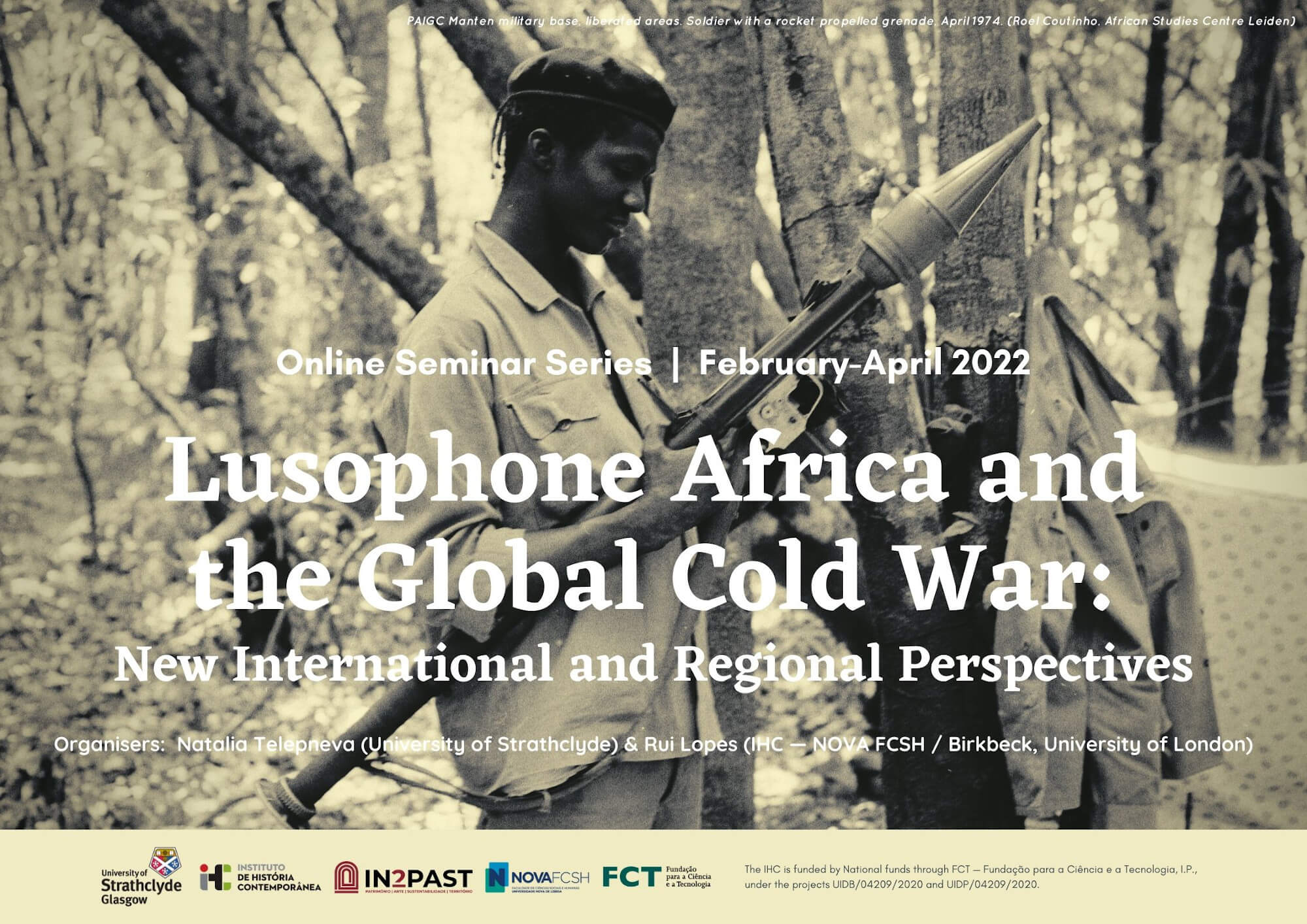
Imagem: Soldado com uma granada propulsada por foguete (RPG) na base militar do PAIGC em Manten
(Roel Coutinho Collection / African Studies Centre Leiden / Wikimedia Commons).
Greater Ireland & Greater Portugal
NOVA FCSH, Colégio Almada Negreiros, Salas 209 e 219
Campus de Campolide da NOVA — 1099-085 Lisboa
{ “@context”: “http://schema.org”,
“@type”: “Event”,
“name”: “Greater Ireland & Greater Portugal”,
“startDate”: “2022-4-7T18-18-00-00”,
“endDate”: “2022-4-9T19-19-00-00”,
“image”:”https://ihc.fcsh.unl.pt/wp-content/uploads/2022/03/2022-04-05_Greater-Ireland_1200x500.jpg”,
“description”:”International colloquium on the comparative history of Portuguese and Irish migrant communities.
Greater Ireland & Greater Portugal
Portugal and Ireland both stand on the periphery of Europe. Both were in”,
“location”:{
“@type”:”Place”,
“name”:”NOVA FCSH, Colégio Almada Negreiros, Salas 209 e 219″,
“address”:”Campus de Campolide da NOVA — 1099-085 Lisboa”
}
}

Detalhes do Evento
International colloquium on the comparative history of Portuguese and Irish migrant communities.
Greater Ireland & Greater Portugal
Portugal and Ireland both stand on the periphery of Europe. Both were in
Ver mais
Detalhes do Evento
International colloquium on the comparative history of Portuguese and Irish migrant communities.
Greater Ireland & Greater Portugal
Portugal and Ireland both stand on the periphery of Europe. Both were in great part defined by their relationship to the sea and to much larger neighbours. Both were imperial nations: Portugal had a territorial empire of its own, while Ireland and the Irish both suffered from and participated in the British Empire. Both saw many tens of thousands of their people leave for all corners of the globe, and both are today still partly defined by these migrations: American politics remain relevant in Ireland, and the affairs of Ireland inform American politics, while the cultural and economic reach of Brazil shapes contemporary Portugal and the wider Lusophone world.
How did this process work? How were culture, language, or historical memory transmitted to, within, and between the various sites of Portuguese and Irish settlements? What connected Irish communities in Boston or Brisbane, or Portuguese communities in Massachusetts or Macau? How were links maintained with ‘home’ and with other sites of settlement? What role dis domestic politics play in community formation and cohesion abroad? Can one discern a ‘Greater Ireland’ or a ‘Greater Portugal’? If so, how did they cohere, have they begun to disintegrate, what characteristics did they share, and how did they differ, either now or in the past?
>> Download the full Programme (PDF) <<
Organisation:
Institute of Contemporary History — NOVA University Lisbon
Keough-Naughton Institute for Irish Studies — University of Notre Dame
Department of History, Maynooth University
Research Institute for Irish and Scottish Studies — University of Aberdeen
Notícias
Xurxo Ayán participa em projecto em Guadalajara
IHC acolhe nova investigadora Marie Curie: Elisa Scaraggi
O IHC vai acolher mais uma investigadora Marie Curie, Elisa Scaraggi.
IHC integra projecto Museus de Brincar
O IHC é um dos parceiros do projecto de criação artística Museus de Brincar, que foi aprovado pela DGArtes.



O conteúdo António João aparece primeiro em ihc.